
All posts by philipmt

Phil Thompson is a husband and father who serves as a lay teacher at The Church at Cherrydale in Greenville, SC and works in the travel industry. He holds a MA in Theological Studies from Liberty Baptist Theological Seminary and an MDiv from Columbia International University.

Church Tech | Online Giving Options Go Head-to-Head

This article continues a series on church technology, particularly geared toward small to medium-sized churches. The previous article covered Church Management Software options.


Besides questions about church management software (and included in those questions), the other most common tech question for churches is how to implement online giving. A host of online giving options exist for churches. Let’s compare seven of the popular options to see how they stack up in an even match-up:
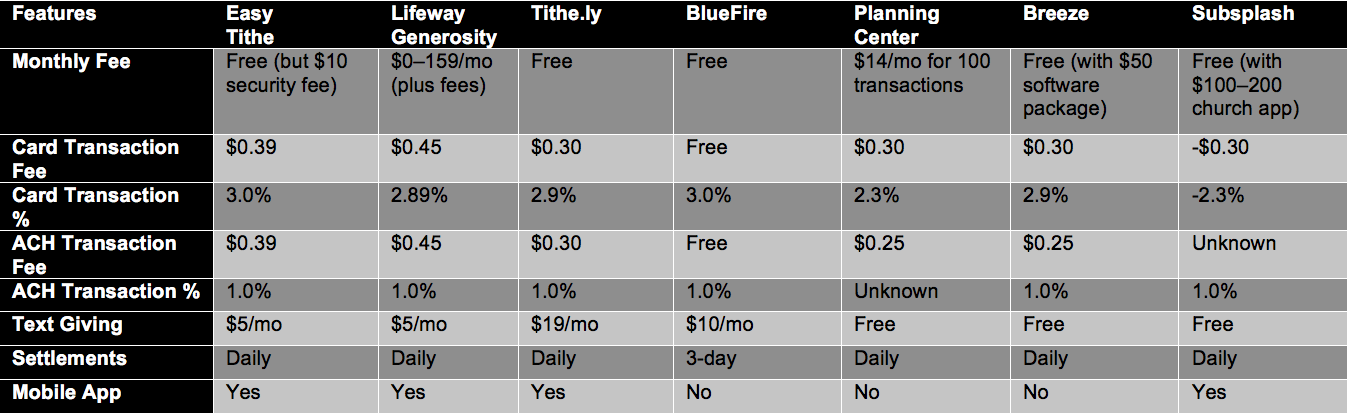
a spreadsheet of church giving apps compared
Click image to expand

It’s worth throwing out a caveat here that some church networks or denominations offer giving platforms with more competitive rates than these. So begin your search there before you begin exploring these options further.

Of the above options, Tithe.ly and BlueFire are fascinating standalone platforms. Tithe.ly has an excellent array of helpful features (including an option for donors to cover transaction fees themselves). BlueFire has the best terms for a standalone service as best I can tell. EasyTithe doesn’t seem to bring much to the table given the current options available to churches, but they have a deep history in providing great service. Lifeway’s platform offers some intriguing features such as non-cash donations and coaching, but the monthly fees and transaction fees are incredibly high. Church plants may be drawn to Lifeway’s 6-month free program; however, they will need to find a better long-term option for the life stage of the plant from 6 months until at least year 1 or 2.

Subsplash is an exciting option for churches who are already in the market for an app for their members. After the setup fee (around $1,000) and while paying a monthly subscription fee (between $100–200), churches can take advantage of some of the lowest processing rates available right out of the gate. But what’s truly unique is that Subsplash uses a metric that they refer to as “GrowCurve”, which decreases credit card processing rates as giving volume increases. This model seems far more attractive than the Planning Center model, which increases a monthly fee as the number of givers increases. But the usefulness of Subsplash giving is contingent on whether your church is in the market for a church app–something that can be helpful for push notifications, sermon note distribution, etc. for a middle age and younger congregation. But an app may not make as much sense for an older congregation or a church with a tight budget. It’s worth considering that churches that need and can afford Subsplash could actually hit a break-even point and recoup their monthly app fees through decreased credit card processing rates.

I’m not confident that the monthly fees for Planning Center are justified, especially as their platform is tied to the amount of transactions per month; however, if your church is already committed to their platform, the additional cost may be worth considering, giving you a unified system for every aspect of your church. One unique aspect of PC’s setup is that they integrate with check readers, a handy tool for increasing counting accuracy, speed, and accountability. Breeze may work well for your church if you have not already committed to another church management software.

Two other financial tools are also worth a mention before we go:

  • Quickbooks: This is the gold standard in accounting software. It’s bulky and non-intuitive (pun intended), but a necessary tool for your church’s finances. Subscription costs normally range from $15 to $45 per month, but the best prices for churches are available on TechSoup.
  • The Cash App: The Cash app by Square is an incredibly simple and free tool for transferring cash from individual-to-individual. Whether you’re paying back another staff member for coffee or you’re a small group leader who wants the group to chip in for pizza, this is the app for you.

What’s working well for your church? Let me know in the comments or on social media.

Church Tech | Church Management Software

One of the perennial questions of pastors and church leaders relates to what church management software is best for their church. Church management software is a challenging investment. Many tools try to do too many things in the life of the church–check-ins, donations, slide presentations, group emails, and the list goes on. Usually, the larger they get, the more likely it is that some of the features or the overall service of the platform falters.

My general recommendation is: find the easiest tool that works well in your areas of need, and supplement it with other tech solutions that function better or easier or cheaper. For example, it’s hard to find products that do kid’s check-in and church people management (essentially a CRM for churches) better than the leading church management software packages. But you may discover that there’s a better solution for processing online donations. In this case, it may be advantageous to abandon the church management software donation component (even if you’re forced to pay for it) and use the other giving tool.

Below, I will highlight three common alternatives for church management software in the expensive, middling, and cheap price bands. These would be my go-to recommendations; however, each one of them has serious weaknesses that the church may need to supplement through other resources.

Planning Center ($$$)

Planning Center is the current gold standard for church management software. Their support is impressive and their constant innovation and improvement of their software is evident. Their solutions are designed to scale for various sizes of churches; however, even at the low end, costs may be prohibitive for smaller ministries.

The strongest features of Planning Center are definitely it’s kids check-in tool and service planning interface. The other four paid features (groups, giving, registrations, and resources) are good, but could easily be supplemented with other standalone software components. That said, if you begin scaling out Planning Center, you may discover that you are best served by using their other services in order to consolidate your data.

Pros:

  • Check-ins sets up rapidly
  • Quick response to support issues and extensive software documentation
  • Excellent design
  • Unique approach to service planning

Cons:

  • Doesn’t play well with other software
  • Incredibly pricey

Breeze ($$)

There’s a lot to love about Breeze. Unlike Planning Center, which parcels out various components for set rates and forces you to upgrade if you cross data thresholds, Breeze has a fixed price per month ($50) and allows unlimited data. In short, it’s church management software made simple for simple and small/medium-sized churches. They use a single dashboard to clearly present all their features and an easy to use way.

One of the cool features of Breeze is its API, which stands for “Application Program Interface.” If you’ve got programmers in your church, this will make them drool. APIs are the mouths and ears of software. They allow Breeze to receive and send information to other apps. This sounds boring, but it’s actually really cool. This means that you can create custom forms to input people into your database. Or you can tie giving data into Quickbooks with ease.

Pros:

  • Simple pricing with no data limits
  • Easy and strong API
  • Strong support, including custom training and importing assistance
  • Built for small/medium-sized churches

Cons:

  • No service planning feature
  • You can find cheaper entry level options

Church Trac ($)

Church Trac has some cheap entry level options (starting at $5/month) and is capable of an incredible variety of tasks. While inexpensive, the lower cost is reflected in the user experience and design. In a lot of ways, the look and feel is similar to 2005 web design. It’s garish and complicated. But it is a tool worth considering if your finances are tight.

Pros:

  • Incredibly cheap
  • Broad variety of features

Cons:

  • Poor design quality
  • Doesn’t play well with other software
Features Planning Center Breeze Church Trac
Check-Ins Yes Yes Yes
Giving Records Yes Yes Yes
Online Giving Yes Yes Yes
Text to Give Yes Yes Yes
Group Management Yes No Yes
Event Registration Yes Yes Yes
People Management Yes Yes Yes
Group Texting Yes Yes Yes
Volunteer Management Yes Yes Yes
Facility Management Yes No Yes
Service Planning Yes No No
No Limits on Data No Yes No
Plays Well With Other Software No Yes No

If you can afford it, I would recommend Planning Center for pure quality and robust capabilities. But I would strongly recommend considering Breeze as a cost saver for church plants, revitalizations, or churches with small budgets. Whichever you choose, commit to it and build out your data within it. Plan on a review of your database and usage of the software on an annual basis.

Honorable Mention

Depending on your church’s needs, you may want to look at some of these platforms:

  • FellowshipOne: Their pricing requires a call, and their software is geared toward large churches. If your church is growing beyond 500 or 1,000, FellowshipOne may be a better option to consider.
  • Realm: This looks like an interesting cloud-based platform with a robust array of features. Pricing isn’t publicly listed, but some sites indicate the pricing is between $30–200/month depending on the plan the church selects. Like FellowshipOne, this seems to be designed with large churches in mind. Realm absorbed another popular people management tool called “The City” some time ago.
  • BAND app: This is an app designed to facilitate group communication, whether for a youth soccer league or for a church small group. It’s a helpful tool that may help fill the communications gap for small group leaders, worship leaders, etc. if your church opts to take a more piecemeal approach to church management software.
  • ChurchTeams: This is another full-featured ChMS with loads of features and pricing ranging from $37–197 per month depending on the size of the church. The user interface appears to leave much to be desired.

Didn’t see your favorite ChMS listed? I’d love to see your comments on what’s working well for you. Do you have some additional pros and cons other churches should consider about the solutions I’ve offered above, please post your own pros and cons.

Three Reasons I Tell My Kids “I Like You”

I caught myself doing it again. My lanky 4-year-old was grinning from ear-to-ear as she showed off her latest skill she’d learned in dance class. I tousled her hair and whispered it: “I like you so much!” I remember one of the first times I said it to her, and it just felt right. I have always told her “I love you,” but now there’s a fresh word in my vocabulary that completes the picture. This isn’t to say that I verbalize either of these words enough, I’m probably about average when it comes to husbands and fathers who fail to speak words of affection to their spouses and kids. But it’s something I want to grow in. And to grow in it, I need to think about it (and write about it). So, after some time pondering why “like” felt so different, here are a few reasons that inspire me to use this word more frequently.

“Love” overlooks the bad; “like” revels in the good.

Deeply rooted in the Christian faith and in western culture more broadly is this notion that “love covers a multitude of sins” (1 Peter 4:8). The power of love is found in its ability to forgive, to heal, and to restore relationships marred by our inevitable human tendency to hurt others. But “like” shows approval in what someone is doing. We frequently have to remind our kids that we do still love them after they’ve done wrong and experienced consequences for their wrongdoing; however, there needs to be a way to high-five them in the good stuff they’re doing. For example, I “like” someone’s Facebook post because it’s something I agree with. So when I tell my daughter that I like her, I’m affirming that she’s doing what seems right to meI want her to feel validated and valued in her father’s mind for the good that she does. There’s nothing more she needs to do, no look she has to achieve, no academic award she has to win, nothing. You’ve got my thumbs up, girl!

“Love” can be done out of duty; “like” demonstrates delight.

You can tell a husband to love his wife. We make this unilateral promise at the altar to love each other until death parts us because love is a volitional responsibility that can be maintained regardless of physical intimacy or emotional connection. Love is a sacrificial and big word that means a whole lot more than we’d often like to admit. But because of its bigness, we can be lulled into feeling that we’ve done our job when we don’t walk out, keep paying the bills and save up for their obscenely expensive college tuition. I understand that love should be more than this, but sometimes we’re too satisfied with achieving the bare minimum of the Great Commands.

So kids need to hear that you delight in them beyond the mere daily obligation you have to them. I “like” my morning cup of coffee because it gives me joy and makes me feel human again. I “like” a good book because it satisfies an intellectual or emotional need. My girls need to hear that I like to see their smiles, to hear them sing, to watch them dance, to comfort them when they’re sad, and to celebrate with them in their successes. Just as I need to know that my Heavenly Father rejoiceshe sings and shouts and claps his handsover me (Zephaniah 3:17), my kids need to know that I feel the same way about them. I don’t begrudgingly carry them, wake up for them, or clean up after them; I exult in them.

“Love” is for the long haul; “like” is in the moment.

Love has this durative capacity that makes it essential for families to work. I will always love my girls regardless of what career choices they make, who they date, where they move, or what they come to believe. But liking someone is an expression of the more fickle sort. It’s here one moment and may be gone the next. While that quality may lead us to devalue telling someone we love that we also like them, I think that it adds a fresh dimension to our value of someone we love. We are souls that exist within the confines of time and space, so there is value in speaking pointedly and exclusively to the present. Telling my girls that I like them speaks to the moment we’re inright here, right nowand tells them that I think they’re wonderful. When I want to speak beyond the long-term and say something intensely appropriate for the present moment, “I like you” is a perfect way to express that feeling.

Bright Monday: A Meditation on the Day After Easter

The familiar ringtone breaks my semi-restful night at the appointed time. Another Monday–another week–arrives with the expected regularity. My routine of mug and bowl and Word seems about the same. Outside, the birds and bugs seem to carry on their everyday rhythm. Cars zip past as yet another workday begins.

But something is different.

The resurrection happened yesterday, did it not? The ground shook and soldiers fell down like dead men. Women gasped in astonishment at empty corpse-wrappings, and men ran with reckless abandon to discover the truth–while others desperately conspired to hide the truth.

But today my life continues as usual.

Or does it?

Bright Monday, for the Christian, is an aftershock of the resurrection. Sure, it’s a return to normal–another swing of the God-ordained weekly pendulum of life, but it’s also so much more than that. It’s the ordinary Monday lived in the brightness of the not-so-ordinary Sunday. The ripple effects of the rolléd stone baptize the Monday ritual of regular work in extraordinary worship to our resurrected King. As every Sunday serves as a resurrection reminder, so every Monday serves as an opportunity to live the new life we’ve been given.

This is the day that the Lord has made;
Let us rejoice and be glad in it.

Christ is risen from the dead,
Trampling down death by death,
And upon those in the tombs
Bestowing life!

Psalm 118:24 with Paschal Troparion (c. 6th century)